Guide | Solo Miners | 10 min read
Which solo miner should I choose: Bitaxe, NerdMiner, or NerdQaxe++?
July 2026By Mario
In short: The NerdMiner T Display S3 is the entry-level model for learning about mining; the Bitaxe Gamma is the quiet workhorse with real hashrate for most home miners; and the NerdQaxe++ is the top-of-the-line model with 4.8 TH/s at 75 watts. Solo mining is a gamble on any device: choose based on what you want to learn and how much you want to spend, not on expected profits. All three are open source.
Which solo miner should you choose if you want to start mining at home? That’s the question I’ve been asked most often in recent months. Three open-source devices in three distinctly different price ranges. They all do the same thing: mine Bitcoin blocks without a pool managing the reward for you. But they do it in very different ways, with very different hashrates, very different power consumption, and very different expectations. This guide provides a fair side-by-side comparison of the NerdMiner T Display S3, the Bitaxe line, and the NerdQaxe++, so you’ll know which device is right for you and why.
A solo miner is a small, open-source Bitcoin device that mines blocks at home without a pool. If you find a block, the full reward (now 3.125 BTC plus transaction fees) goes straight to your own wallet, with no middleman. That is the principle. The honest part of the story: the odds are small.
Table of contents
- Is solo mining worth it?
- Which solo miner to Choose: The Three Candidates
- NerdMiner T Display S3: the entry-level model
- Bitaxe: The Quiet Workhorse
- NerdQaxe++: the maximum
- Comparison table
- Which one suits you?
- Where can you buy a solo miner in the Netherlands?
- Frequently asked questions
Is solo mining worth it?
Is solo mining worth it? That depends on what you expect. Solo mining is not a steady income. You do not share in a pool, there is no monthly payout and nobody guarantees you anything. The Bitcoin network hashrate is currently roughly 800 EH/s (exahashes per second). With the most powerful open-source home miner in this overview, the NerdQaxe++ at 4.8 TH/s, your chance of finding a block per minute is roughly 1 in 10 billion. That’s the reality. Treat it like a Bitcoin lottery, not as a source of income.
But it’s worth it for three good reasons. First, you’re actively supporting the decentralization of the Bitcoin network. Every hash you compute is a hash that isn’t controlled by a large pool operator. That contributes to the security and distribution of the protocol. Second, you’ll learn how Bitcoin mining really works: what difficulty does, what a share is, how a pool communicates with a miner, and what it means to mine blocks autonomously. You won’t just read about it in an article, you’ll see it happen live on your desktop. Third, there’s a chance of finding a block. It’s astronomically small, but not zero. Parasite Space once found a block using a similar open-source device. Read how that went and you understand why home miners do it.
A small miner on your desk that takes part in the Bitcoin network 24 hours a day, does its own SHA-256 calculations and is connected to the blockchain on its own: that feels different from reading about it. It is about the principle.
Which solo miner to Choose: The Three Candidates
Now that expectations are in order: which solo miner should you choose from the three available? Each miner has its own profile, its own user group and its own trade-offs. Price is only part of it.
The NerdMiner T Display S3 is the entry-level device: the cheapest open-source mining device you can buy, featuring a built-in display, low hashrate, and minimal power consumption. The Bitaxe line is the professional middle ground: genuine ASIC chips, significantly higher hashrate than the NerdMiner, quiet and energy-efficient, three models at three price points. The NerdQaxe++ is the most powerful open-source option available right now: 4.8 TH/s in a compact format, built for those who want the maximum.
The question “which solo miner to choose” is really two questions at once. What is your budget? And what is your goal? If you want to learn how mining works, you choose differently than if you want the maximum out of your home setup.
NerdMiner T Display S3: the entry-level model

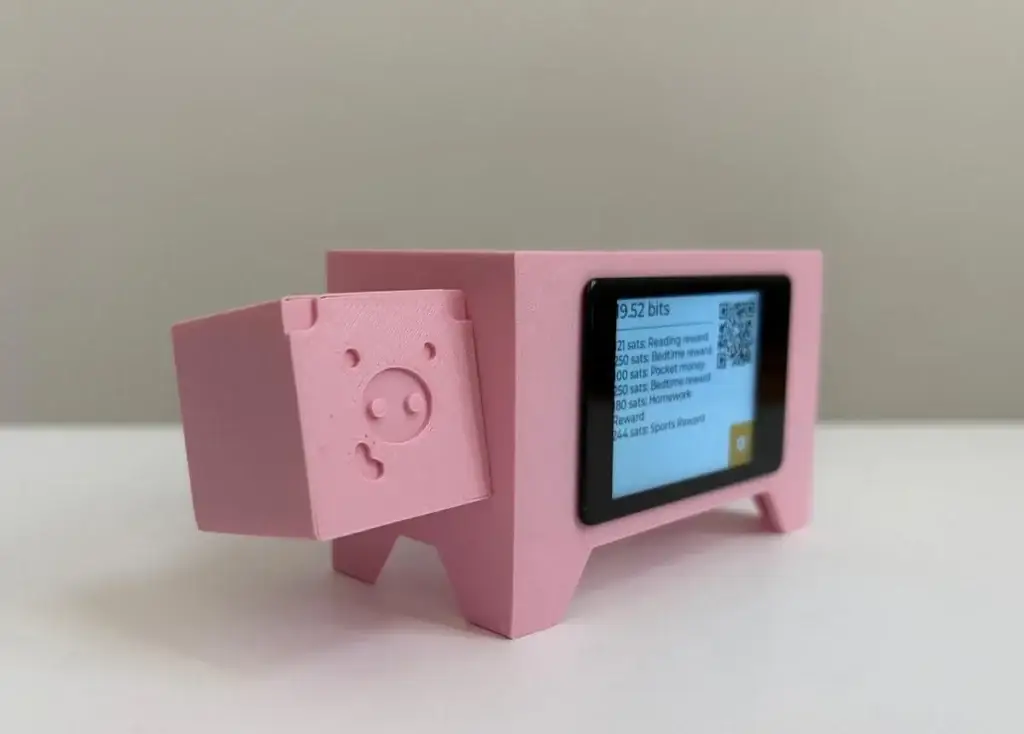
The NerdMiner T Display S3 is the cheapest open-source Bitcoin mining device I know and a good way to understand what solo mining really is. The hashrate is low. It is a real, working Bitcoin mining device that is active on the network day and night.
The device runs on an ESP32 microcontroller and consumes less than 1 watt. The built-in color display shows you the hashrate, connection status, Bitcoin price, and feedback on the mining process in real time. Just plug it into a USB power adapter (included or a standard phone charger) and connect it to your Wi-Fi network, and it does its thing. No firmware installation via a pocket PC, no soldering, no command lines. You’ll be up and running in 15 minutes, and the only configuration required is your Wi-Fi password and your own Bitcoin wallet address.
The NerdMiner T Display S3 is suitable for beginners who want to understand how mining works, for children encountering Bitcoin technology for the first time, and for anyone who wants to spend a small amount on practical learning instead of theoretical reading. The hashrate is low compared to the Bitaxe or the NerdQAxe++, but the experience is real. You see live how the mining process runs, how difficulty adjustments take effect and how a device stays connected to the network. And if you want more out of it later, you step up to the Bitaxe Gamma.
- Hashrate: ~77 KH/s (ESP32 microcontroller, no ASIC)
- Power consumption: less than 1 watt
- Price: see product page
- Suitable for: beginners, children, learning by doing
Bitaxe: The Quiet Workhorse

The Bitaxe is in a completely different category than the NerdMiner. Whereas the NerdMiner runs on a microcontroller, the Bitaxe runs on real ASIC chips: the same type of specialized hardware found in commercial Bitcoin miners, but in an open-source, compact enclosure that you can place on your desk. The Bitaxe project is completely open-source. Hardware schematics, firmware (AxeOS), PCB designs, everything is available at GitHub, everyone can build or customize it. That is the philosophy behind the project and that is why the community stands behind it.
We sell three models from the Bitaxe line:
Bitaxe Supra This is the entry-level model in the Bitaxe line. It is ASIC-based with a BM1368 chip (~700 GH/s, ~15W), offers more hashrate than the NerdMiner, and is still the cheapest ASIC option in the line. A good middle ground if the Gamma is too expensive but the NerdMiner feels like it doesn’t offer enough.
Bitaxe Gamma is the model I would choose myself if I bought one tomorrow. The Gamma has a good price-to-quality ratio in the line: BM1370 chip, ~1.1 TH/s hashrate, ~18W power consumption, quiet and well documented by the open-source community. It is the most complete choice for a serious home miner. This is the model I recommend most often to people who go from “I am curious” to “I am really doing this”.
All Bitaxe models are configured via the AxeOS web dashboard. You can open it in your browser as soon as the miner is connected to your network. Enter your own Bitcoin wallet address, select your pool (SoloPool.org for true solo mining, or a public pool if you want to compare results immediately), and click “Save.” You can keep track of firmware updates via the dashboard itself or through the Bitaxe GitHub community and its Discord server. The community is active, and documentation is widely available.
- Bitaxe Supra: ~700 GH/s (BM1368 ASIC chip), ~15W
- Bitaxe Range: ~1.1 TH/s (BM1370 ASIC chip), ~18W
- Price: see product page
- Suitable for: serious home miners, quiet and energy-efficient setup
We previously wrote a detailed comparison of the two most powerful Bitaxe models: Our in-depth Bitaxe vs. NerdQaxe++ test. In it, we delve deeper into the technical details of both devices side by side.
NerdQaxe++: the maximum

The NerdQAxe++ is the most powerful open-source home mining device in our range. At 4.8 TH/s it gives you the greatest possible chance at a block of all devices in this comparison, while still being compact enough to put on a desk or shelf.
The NerdQAxe++ gets its hashrate from 4 BM1370 chips (the same chip as in the Antminer S21 Pro) and has an active cooling system for the higher heat output. It uses ~75W (~EUR 16/month). You cannot just stick it in a cabinet without thinking: ventilation has to be good and the noise level is higher than with the Gamma. But it is not an engineering project either. Configuration is done through a web dashboard, just like the Bitaxe.
Are the odds with the NerdQAxe++ big? No. With 4.8 TH/s against roughly 800 EH/s of network hashrate, the chance per minute is about 1 in 10 billion. That is the honest calculation. The NerdQAxe++ is not a source of income, it is the most powerful home mining experiment available. If you want to contribute to decentralization with the maximum effort a home miner can deliver, and you have realistic expectations about the odds, this is your device.
- Hashrate: 4.8 TH/s (4x BM1370, Antminer S21 Pro)
- Power use: ~75W (~EUR 16/month)
- Price: see product page
- Suitable for: serious home miners who want the maximum
Comparison table
| Device | Hashrate | Suitable for |
|---|---|---|
| NerdMiner T Display S3 | ~77 KH/s (ESP32, no ASIC) | Beginners, children |
| Bitaxe Supra | ~700 GH/s (BM1368 ASIC) | Budget-Bitaxe |
| Bitaxe Gamma | ~1.1 TH/s (BM1370 ASIC) | Best balance |
| Bitaxe Naja Duo | 4.4 TH/s (2x BM1373) | Lots of hashrate, low power draw |
| NerdQaxe++ | 4.8 TH/s (4x BM1370) | Maximum hashrate |
Which one suits you?
This is what I say when someone asks me which solo miner to choose:
Choose the NerdMiner T Display S3 as your budget is small, you want to understand how mining works without much risk, or you want to show a child what Bitcoin mining is in practice. You do not get serious hashrate here. You pay for understanding and experience, and that has its own value.
Choose the Bitaxe Supra as If you feel the NerdMiner isn't quite enough but don't want to pay for the Gamma right away. ASIC-based, more serious than the NerdMiner, an affordable entry point into the true Bitaxe line.
Choose the Bitaxe Gamma as you are looking for the best balance. Hashrate, silence, energy use, price and community support come together here in the most complete mix. This is the model I would choose myself if I bought one tomorrow.
Choose the NerdQaxe++ if you want the maximum and you have realistic expectations. You know what solo mining is, you understand probability, and you want the most powerful open-source device available.
Two things I always tell people about this choice. First: this is not an income model. Do not count on monthly earnings and do not calculate your ROI from expected block rewards. Second: if you understand the principle of solo mining and want to contribute to the decentralization of the network, it actually does not matter which device you choose. They all do the same thing, at their own scale.
Where can you buy a solo miner in the Netherlands?
We are a Dutch Bitcoin-only shop. I only sell things I would use myself, have tested or would recommend. That promise has stood for three years.
You can pay in euros (iDEAL, credit card) or in Bitcoin. All devices are delivered new, never refurbished or second-hand. They come in original, sealed packaging with all necessary connections.
We are a Dutch seller with a fixed contact address, trackable parcel shipping and a returns policy. Not sure which model suits you? Write to us and we will help you choose.
P.S. Do you have questions that are not answered here? Write to me.