Guide | Solo Miners | 10 min read
How to Buy NerdQaxe++: Setup in 4 Steps + Honest Review
July 2026By Mario
Has anyone actually found a bitcoin block at home yet?
In April 2026, three people discovered just that, using a NerdQaxe++, a little device that was just sitting on their desk. Total value of those three blocks: more than $560,000 (community-reported). This is the honest setup guide for anyone who wants to Buy NerdQaxe++ considers: what the device does, how realistic the chances actually are, and how to get it mining in four steps.
What is NerdQaxe++, and how does solo mining work?
The NerdQaxe++ is an open-source bitcoin solo miner, no larger than a deck of playing cards. The current version (Rev 7) delivers a hashrate of 4.8 TH/s while consuming approximately 72 to 76 watts, depending on the operational settings and the source you consult. Inside are four Bitmain BM1370 chips, the same ASIC chips used in professional miners from larger manufacturers. The efficiency is approximately 15.0 to 15.8 joules per terahash.

Solo mining works differently from pool mining. In a pool, you pool your hashrate with hundreds or thousands of other miners and receive small, regular payouts based on your share. With solo mining, you compete as an individual for an entire bitcoin block. No shared reward, no daily payouts. Either you find a block, or you don’t. The reward if you do: currently 3.125 BTC plus the transaction fees from all transactions in that block.
The Buy NerdQaxe++ is not something you do for a predictable return. You buy a place in the network and a chance at a block. Anyone who wants to buy the NerdQaxe++ as part of their bitcoin stack does so with open eyes about the odds. Open source, verifiable code, everything transparent: with bitcoin you can check what happens behind the screen.
Another important point: the NerdQaxe++ contributes to the decentralization of the Bitcoin network. Every unit of hashrate running outside of large data centers makes the network harder to centralize. If you run the NerdQaxe++ at home, you’re no longer a passive holder. You’re actively participating in the network itself.
In this context, "open source" also means you don't have to take a vendor's word for it. The NerdQaxe++ firmware (AxeOS, based on ESP-Miner) is publicly available on GitHub. The hardware designs for the NerdQaxe++ are freely available. You can verify for yourself what the device does, how the hashrate is calculated, and how the connection to the pool works. That’s something no proprietary mining hardware can offer you. And it’s exactly the kind of transparency that aligns with Bitcoin: don’t trust, verify.
Chance of a block: actual odds
Let’s be honest: the chances are very slim. In July 2026, Bitcoin’s network hashrate was approximately 900 EH/s (exahashes per second). The NerdQaxe++ delivers 4.8 TH/s. Your share is 4.8 / 900,000,000 = approximately 0.00000053 percent. Statistically speaking, with a NerdQaxe++, it will take approximately 3,500 years before you can expect to find a block. That’s not fifty years, not a hundred years. Thousands of years.
But statistics works both ways, and that is precisely what the Buy NerdQaxe++ makes it interesting. An expected duration of 3,500 years does not mean it will take 3,500 years. It means there’s a new lottery every ten minutes, and you participate in every draw. The outcome of each block is independent of all previous draws: Bitcoin has no memory. Anyone who finds a block today had just as small a chance yesterday.
You can calculate the current network hashrate and the statistical probabilities yourself via mempool.space. The site shows the hashrate, block frequency, and reward value per block in real-time. More honest than a sales brochure.
Two things are worth understanding here. First: Bitcoin hashrate has historically grown every year. That means the expected time per device gets a little longer each year if you do not expand. Second: the block reward is halved every four years (the halving). The current block reward is 3.125 BTC. That makes the timing of when you start relevant to the value of a possible find, although there is no guarantee which direction that value moves. The mathematical reality is simple: more hashrate, more chance. More miners at home in the network, more decentralized. That second point is an ideological consideration.
Has anyone found a block using the NerdQaxe++ yet?
Yes. In April 2026 three bitcoin blocks were found that are community-reported to NerdQaxe++ devices, with a total value of more than $560,000. Those finds spread quickly in the open-source Bitcoin community because they show that solo mining at home is not purely theoretical. Three hits in one month, on devices with statistically a one in 3,500 years chance each.
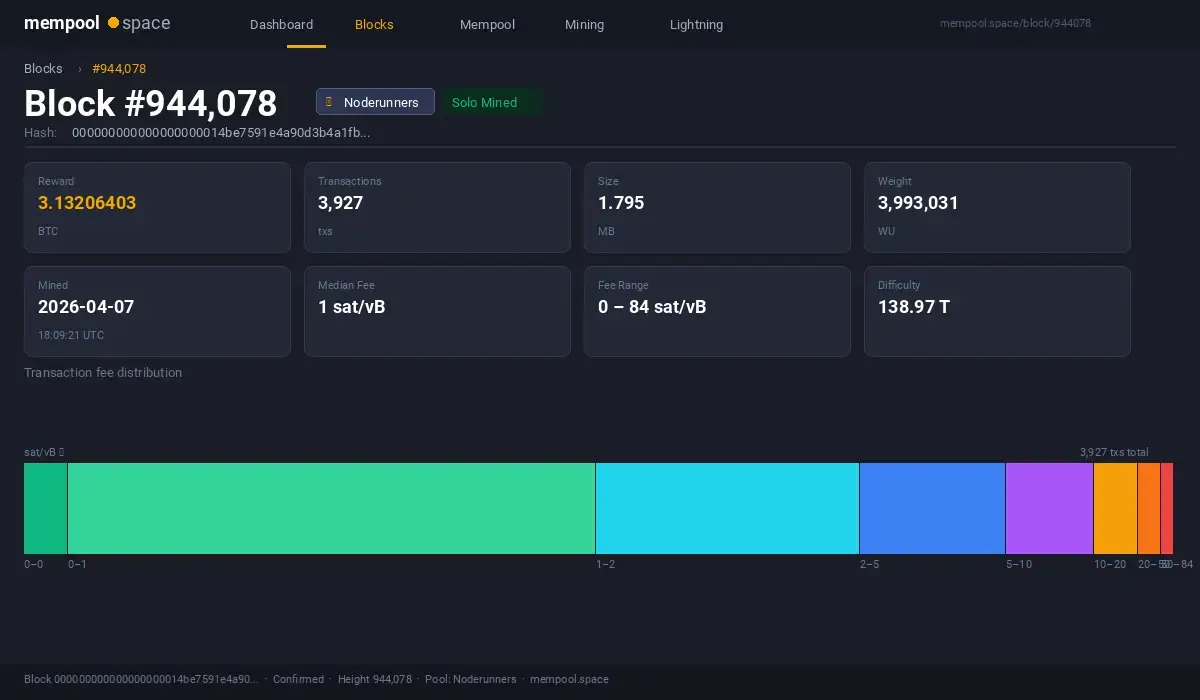
Is the Buy NerdQaxe++ a device that earns money? I cannot promise that. Is it a device with which community members demonstrably won blocks in 2026? Yes. Both are true, and it is important not to mix them up.
The block finds can be followed publicly on CKPool's solo statistics. The public pool statistics from CKPool are open to everyone: you can see recent blocks and the global pool hashrate.
Step-by-Step Guide to Setting Up NerdQaxe++ with AxeOS
The NerdQaxe++ runs on AxeOS (open-source, based on ESP-Miner firmware). The device does not have an Ethernet port. The setup process is done via Wi-Fi: when you first power it on, the device creates its own configuration hotspot that you connect to in order to set up your home network. You’ll need: a NerdQaxe++, a laptop or phone with Wi-Fi, and your own bitcoin receiver address.
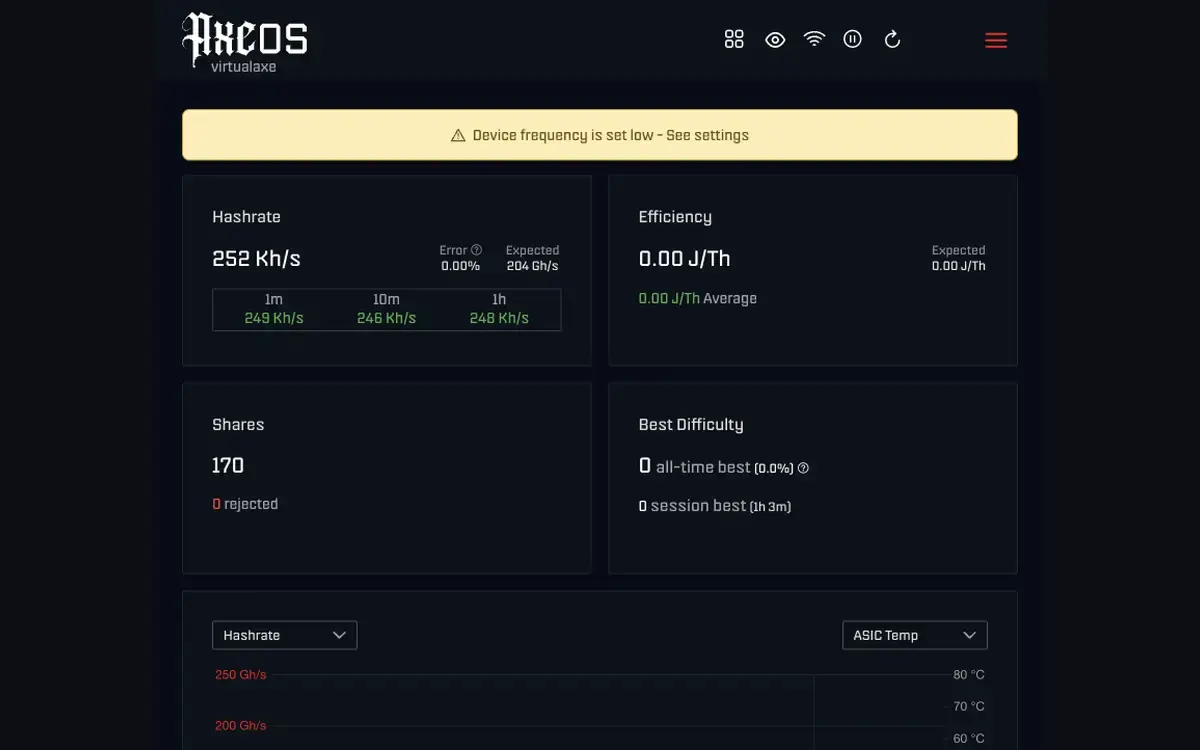
Step 1: Turn on the NerdQaxe++ and connect to the configuration Wi-Fi network
Connect the NerdQaxe++ to a power source. The device will start up and create its own Wi-Fi hotspot (a configuration access point). Search for this Wi-Fi network on your laptop or phone and connect to it.
Step 2: Set up your home network via the configuration portal
After you connect to the configuration hotspot, the AxeOS configuration portal will open in your browser. Enter the name (SSID) and password for your home network here. The NerdQaxe++ will then automatically connect to your home network, and the configuration hotspot will disappear.
Step 3: Open the AxeOS interface and enter your bitcoin address
Look up the IP address of the NerdQaxe++ via your router or via mDNS (the device is reachable through its own hostname). Type the address in your browser: the full AxeOS interface opens. Enter your own bitcoin receiving address here. This is the address that receives the block reward if you find a block. Use a non-custodial wallet, preferably a hardware wallet. Not your keys, not your coins.
Step 4: Configure the mining pool and start
Enter the pool URL for the solo mining pool of your choice. Save the settings, and the NerdQaxe++ will start mining immediately. In the dashboard, you’ll see the hashrate increase and the first accepted shares come in. An accepted share is proof that your device contributed to the search, even if you didn’t find the block yourself.
Ready. The Buy NerdQaxe++ and setting it up takes less than an evening.
Once you've set it up, you can monitor the NerdQaxe++ in real time via the AxeOS dashboard: hashrate, shares, and connection status. Is something going wrong? The most common cause is an incorrect bitcoin address or an incorrect pool URL. AxeOS displays an error message if it cannot connect to the pool. Fix that in the settings, restart the connection, and you’re back on track.
NerdQaxe++ vs. Bitaxe Gamma: Which One Should You Choose?
Are you hesitating between the Buy NerdQaxe++ Or should you start with the Bitaxe Gamma? The NerdQaxe++ offers more hashrate, while the Bitaxe Gamma is the more affordable entry-level option. Both are open source, both run AxeOS, and both are suitable for solo mining at home. The differences lie in scale.
| Property | NerdQaxe++ Rev. 7 | Bitaxe Gamma |
|---|---|---|
| Chips | 4x Bitmain BM1370 | 1x Bitmain BM1370 |
| Hashrate | 4.8 TH/s | about 1.1 TH/s |
| Power consumption | approximately 72 to 76 W | about 15 to 20 W |
| Efficiency | 15.0 to 15.8 J/TH | depending on tuning |
| Firmware | AxeOS | AxeOS |
| Open source | Yes | Yes |
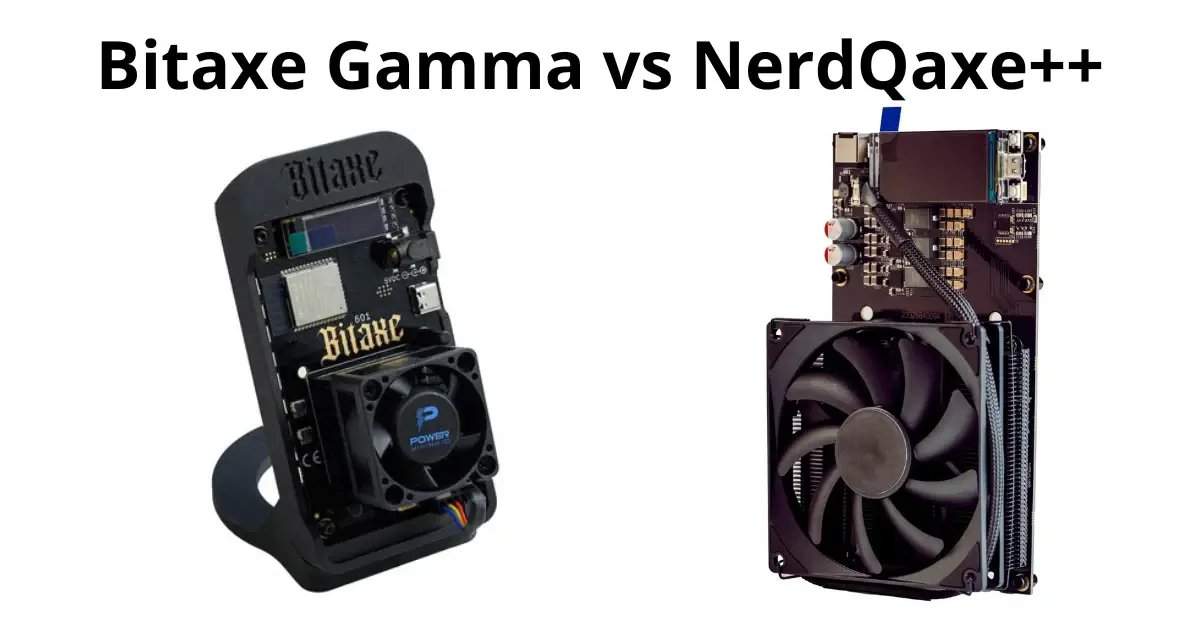
The Buy NerdQaxe++ provides four times the hashrate of the Bitaxe Gamma, while consuming four times as much power. The statistical probability of mining a block is proportionally higher: with the Bitaxe Gamma, the expected wait time is even longer. It’s a matter of scale, not technology, since both devices use the same AxeOS approach.
The Bitaxe Gamma is the logical entry-level model: cheaper, smaller, and more energy-efficient. For anyone who wants to start solo mining at home without going all-in right away, the Bitaxe Gamma is the perfect starting point. Our Bitaxe Gamma Installation Guide Explain the setup step by step.
There's also the NerdMiner T-Display, a compact option with a significantly lower hashrate and a different architecture, designed for those who want to get started with the absolute minimum. The NerdMiner T-Display Installation Guide describes how to set it up.
Three devices, three tiers. The NerdQaxe++ falls right in the middle: more than a NerdMiner, less than a server rack full of professional ASIC miners. Just right for anyone who wants to take solo bitcoin mining at home seriously without building a professional setup.
How much power does the NerdQaxe++ consume?
The NerdQaxe++ Rev 7 consumes approximately 72 to 76 watts, depending on the operating settings. At a Dutch electricity rate of 0.30 to 0.40 euros per kWh:
- Per day: 76 W x 24 hours = 1.824 kWh = 0.55 to 0.73 euros
- Per month: approximately 17 to 22 euros for electricity
- Per year: approximately 200 to 265 euros for electricity
By way of comparison: the Bitaxe Gamma consumes about 15 to 20 watts, which amounts to about 3.30 to 6.00 euros per month. Anyone who buys the NerdQaxe++ for its higher hashrate will pay three to five times more in electricity costs.
Who is the NerdQaxe++ intended for?
The NerdQaxe++ is not for everyone.
The NerdQaxe++ is designed for Bitcoin enthusiasts who have moved beyond the first step. It’s for those who already own a hardware wallet, understand how keys work, and want to experiment with the technical aspects of the network. For those who don’t want to answer the question “How does bitcoin mining work?” with a YouTube video, but rather with a device on their desk.
Solo bitcoin mining at home is a way to understand the network from the inside. You see what hashrate means, you understand how blocks are found and you see for yourself why Bitcoin is decentralized: you, at home, are running as part of the network.
For those who want to start solo mining at home for the first time, we recommend the Bitaxe Gamma as a starter model. It’s cheaper, smaller, and uses less power. If you want more after that, the Buy NerdQaxe++ the logical next step. And for the absolute beginner who just wants to see how it works, the NerdMiner T-Display is the perfect way to get started.
Frequently asked questions
Conclusion: Is the NerdQaxe++ worth buying?
That depends on what you expect.
If you are looking for a guaranteed return, this is the wrong device. Statistically it takes about 3,500 years to find a block with a NerdQaxe++. You know that up front.
If you participate in the Bitcoin network, want to take the statistical chance of mining a block, and are willing to pay about twenty euros a month in electricity costs for that chance, then the Buy NerdQaxe++ a serious consideration. Four Bitmain BM1370 chips, 4.8 TH/s, AxeOS firmware, all open source. And three community members in April 2026 proving that the exception exists.
Anyone who buys the NerdQaxe++ does something most Bitcoiners do not: besides holding bitcoin, you contribute to the network with your own hashrate. That is how Proof of Work works.
P.S. Do not count on income: you are buying a place in the network.