Guide | Bitcoin Basics | 12 min read
Bitcoin Self-Storage Mistakes: 8 Pitfalls to Avoid
July 2026By Mario
What if your bitcoin setup seems secure, but your backup turns out to be the weak link? That’s where self-hosting often goes wrong, not because of the big picture, but because of small, silly, human errors. Taking a photo. Quickly uploading something to the cloud. Deleting everything from an exchange too quickly without testing. Or creating a passphrase that you can’t even remember later.
Managing Bitcoin yourself gives you freedom. That’s exactly why it’s serious business. It’s not complicated just for the sake of being complicated, but simple enough to manage effectively without any confusion. You don't have to become paranoid. Above all, you must rule out predictable mistakes.
This guide is here for that. No fear-driven sales. No crypto-talk. Just the 8 mistakes I keep seeing over and over, why they hurt, and how you can sensibly prevent them.
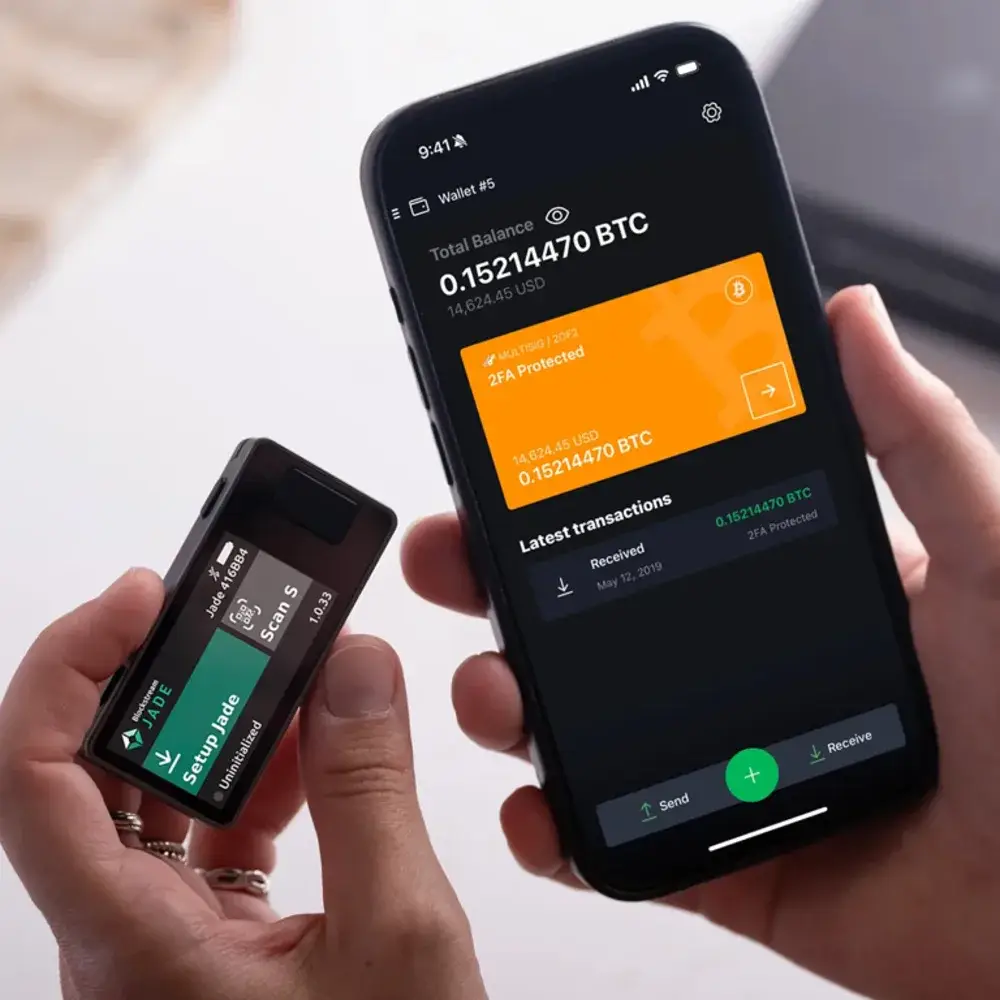
Direct answer: The biggest bitcoin self-custody mistakes are storing your seed phrase digitally, leaving bitcoin on an exchange, failing to test a backup, and using a wallet or passphrase that you don’t really understand. Self-custody only works well if your setup is simple, tested, and recoverable.
Table of Contents:
- What do we mean by “bitcoin self-storage”?
- The 8 biggest mistakes
- Which error to fix first
- A sober buying bridge
- Conclusion
- FAQ
What do we mean by “bitcoin self-storage”?
Keeping your Bitcoin yourself means you’re the one in control of the keys. Not an exchange, not an app with a support desk, not a third party that promises everything will be fine. That’s the essence of “not your keys, not your coins.” It sounds harsh, but it saves a lot of confusion.
A seed phrase is the sequence of words used to restore your wallet. Whoever has those words ultimately has access to your bitcoin. That’s why a seed phrase isn’t just a note. It’s the key to the safe.
Many beginners read a broad starter guide first, and that is fine. If you are still missing the basics, start with Storing bitcoin for Beginners. This guide tackles a different question: not how you start, but where it goes wrong when you think you've already started.
The 8 biggest mistakes
1. Store your seed phrase digitally
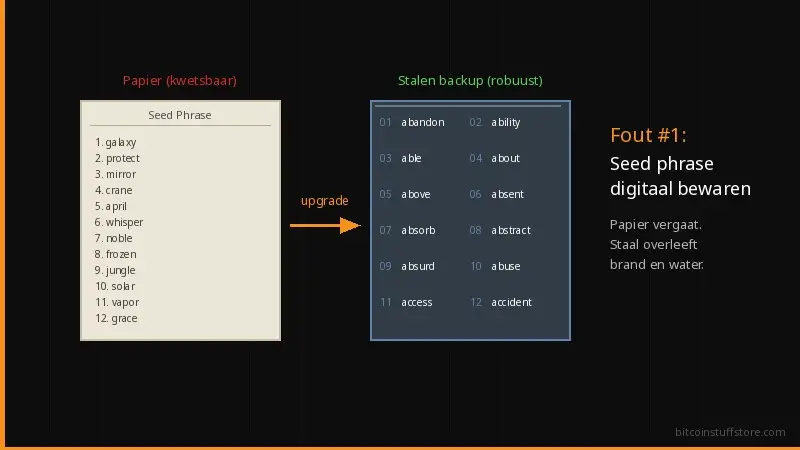
This is by far the most underestimated mistake. People take a photo, save the words in Notes, email them to themselves, or put a scan in the cloud. That feels convenient. It is also precisely the problem.
A phone syncs. A laptop makes backups. A cloud account can be hacked. And malware doesn’t look for philosophy, but for easy loot. There is also a more subtle layer: your password manager. That feels safe, because everything is stored encrypted. Until a major data leak exposes the encrypted vaults. Anyone who has the right master password at that point can open them. For regular login credentials, that is already annoying. For a seed phrase, it is definitive: there is no bank that will reimburse you and no recovery option.
A seed phrase that has ever appeared on a screen, keyboard, or online account has already left too many traces.
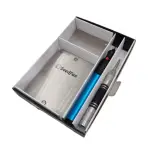
The solution is boring, and that is why it works. Copy your seed phrase calmly. Store it offline. And if you want to go beyond paper, put it on steel so that water, fire, and wear are not immediately the end of your setup. For that part, the Seedfan Steel Kit Verified live as in stock on 2026-07-04. That is not a glamour upgrade. That is damage control.
[Image 1: Close-up of a seed phrase on paper next to a backup sample. Alt: bitcoin self-storage errors in seed phrase backup.]
Not having a real backup
Technically, some people have a backup, but practically they do not. A piece of paper in the same drawer as the wallet is not diversification. A seed phrase at home, without a backup plan, brings no peace of mind. That is just hoping nothing happens.
The mistake is not just not having a backup. The mistake is thinking that a single vulnerable backup is enough. Paper can get wet, fade, or simply disappear, especially if you only discover after a move, a short circuit, or a cleanup day that your plan actually consisted of a loose habit.
What works better? At a minimum, a setup that is separate from the device itself. Multiple locations. And when your amounts get serious, don't just think in terms of backup, but also the medium. Paper has limits. Steel survives fire, water, and time. That is less cool than a multisig thread on X, but for most people much smarter.
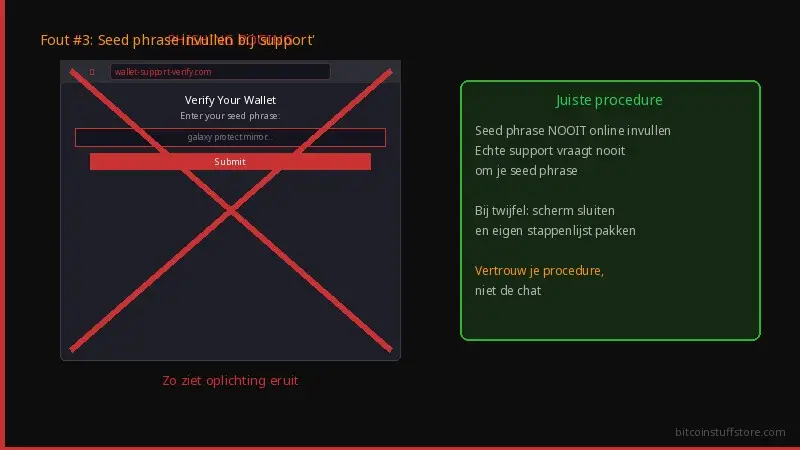
3. Typing your seed phrase on a website or in a support chat
This is often where things go wrong as soon as stress sets in. A wallet acts weird. Your laptop crashes. You think you are talking to support. Someone sends a link. And before you know it, you are typing in the exact thing you should never enter anywhere.
For the record: a real wallet will only ask for your seed phrase back during the recovery step of a wallet that you trust yourself and have consciously opened. Not in a browser window. Not in Telegram. Not in a chat with a profile picture and a polite tone.
[Image 2: Screenshot-style image of a fake support chat or phishing screen without brand logos. Alt: bitcoin: Keep your own seed phrase safe from phishing.]
Not trusting support, but trusting your procedure. That is the core. If a situation feels rushed, you stop. Close your screen. Take out your own checklist. A seed phrase should never end up in a form.
4. Leave Bitcoin on the exchange because it's still just as easy for now
This is the best-known mistake, but precisely for that reason, it easily slips past you. An exchange feels fast. The interface works. Buying succeeds. Selling succeeds. And as long as nothing goes wrong, it feels like ownership and access are the same thing.
They are not. An exchange is a counterparty. You have a login, but not the keys.
History shows how that ends. Mt. Gox went bankrupt in 2014, leaving an estimated 850,000 bitcoin from users with nowhere to go. FTX collapsed in 2022, taking billions in customer funds with it. Celsius froze all withdrawals that same year before going bankrupt. Three platforms, three stories, the same outcome: the exchange held the keys, not the user.
Self-custody doesn't have to start perfectly. Just genuinely. If you're still doubting which setup suits you, also read Compare bitcoin and hardware wallet and Buy hardware wallet in the Netherlands. That is where the practical decision support is. This is where the error prevention is.
5. Buying a used or unfamiliar hardware wallet
People want to save money, but they end up looking in the wrong places. A hardware wallet isn't a vintage amplifier. You don't want an unknown history, opened packaging, or any doubt about what happened to that device before it came to you.
Supply chain risk sounds big, but the reality is simple. If you are not sure where the device comes from, why would you trust it with your keys? Buying cheap and then doubting for months is not a profit. That is noise.
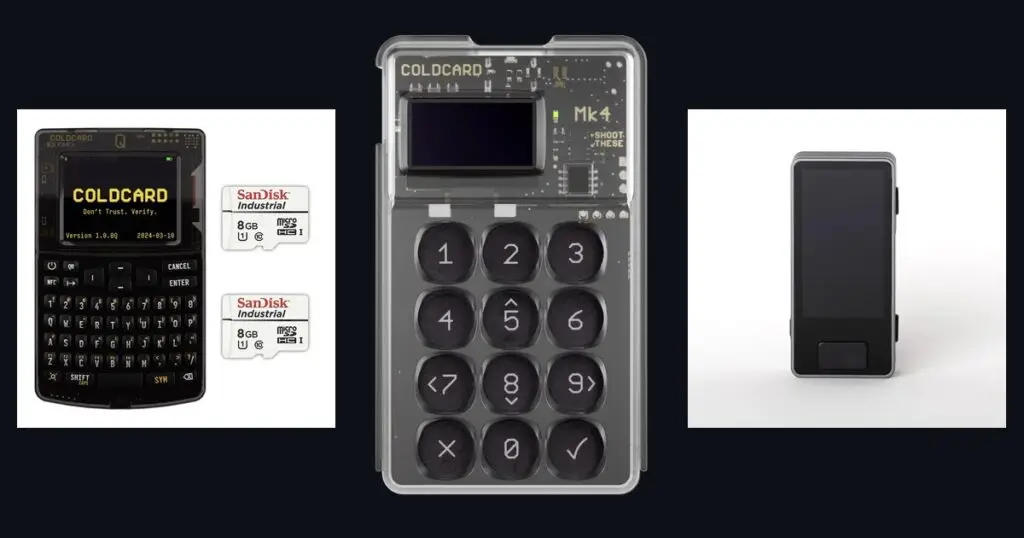
Buy new. Buy sealed. Buy from a seller who specializes in bitcoin and isn't also pushing twenty crypto tokens and three casino links. That not only reduces risk, but also saves you a headache. The category hardware wallets is this a logical starting point, precisely because you can place models and levels side by side there.
6. Do not perform a test transaction
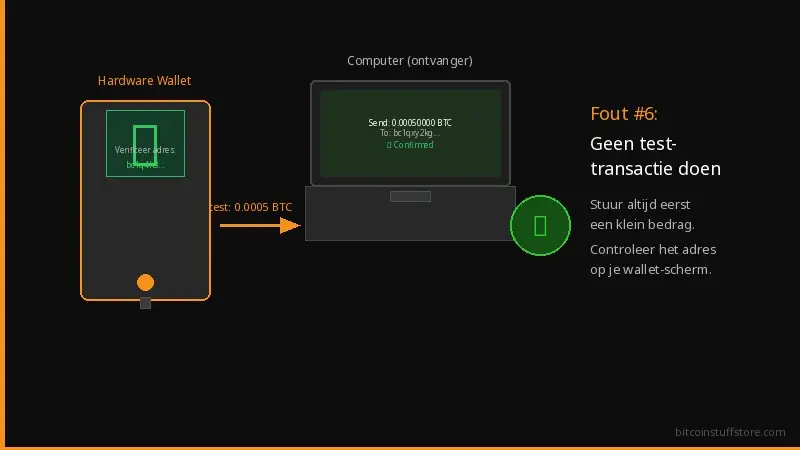
This is the kind of mistake that comes from being in a hurry. You’ve finally decided to leave the exchange, so you want to push through. Understandable. But if you immediately send your entire amount without sending a small test amount first, you create stress for yourself that you could have easily avoided.
There’s also a technical reason to be cautious. There is malware that secretly replaces the address in your clipboard the moment you paste it. You copy address A, but when you paste it, address B, the attacker’s address, appears instead. This is called address substitution, and it works precisely during that fleeting moment of copy-and-paste. If you don’t then verify the recipient address on your hardware wallet screen (not just on your computer), you’ll send your bitcoin to someone else. A test transaction with a small amount forces you to do that check, right at the moment when it won’t cost you much.
[Image 3: hardware wallet next to a laptop showing a small test transaction. Alt: bitcoin storing test transaction errors itself.]
A test transaction is not excessive. It is a functional check. Is the address correct? Do you see the receipt? Do you truly understand the flow of sending and receiving? Those few minutes of peace of mind are much cheaper than a mistake on a large amount.
7. Never practice recovery
Many people test the device, but not the recovery process. That feels safe, but it’s only half the job. Just because your wallet is working today doesn’t mean you’ll still be able to access your bitcoin tomorrow if the device breaks, gets lost, or is wiped.
Recovery testing doesn't mean you should go tinkering recklessly. It means you verify in a controlled manner whether your seed phrase is correct, legible, and can actually be restored on a wallet intended for that purpose. Otherwise, you aren't relying on a backup, but on an assumption.
This is also where simple setups win. The more layers you add without understanding them, the greater the chance that recovery will actually become more difficult. Not more complex, but more robust. That is the game.
8. An incorrect passphrase or inheritance plan
A passphrase can be clever. It can also be a wonderful way to lock yourself out. Many people hear that an extra word is safer and take that step before they realize what it means practically.
A passphrase is not a small password on top of your seed. It actually changes which wallet you open. If you lose that passphrase, you still have a problem even with a perfect seed phrase. That does not make it a bad idea. It makes it an advanced step that you only take if you truly understand it and document it well.
Therefore, something painful yet healthy applies to most people: A simple single-sig setup that you fully understand is better than a clever setup that you half understand. That sounds less sexy. It is usually true, though.
But there is another single point of failure that people consistently overlook: the estate plan, or rather, the lack of one. You know where everything is. And then you are no longer here, or you are temporarily out of reach. Who can access it then?
Self-custody is sovereignty. But sovereignty that ends with you as an individual is also a vulnerability. If you’re the only one who knows where your seed phrase is and you pass away, your bitcoin is likely lost forever. If all your backups are stored in one location and that location burns down, there’s nothing to recover. One location, one person who knows: that’s not a plan, it’s a risk.
It doesn’t have to be complicated. A letter at the notary’s office. A safe with instructions. An agreed-upon procedure with a partner who knows how to recover the funds, without that partner needing to know the seed phrase itself. The protocol doesn’t need to contain the seed phrase, just the path to it. Bitcoin is sustainable across generations. Your storage strategy should be, too.
Which error to fix first
If you are thinking right now: nice story, but where do I start, tackle it in this order.
- Remove your seed phrase from every digital trace. Immediately.
- Provide an offline backup that is legible and logically stored.
- Move bitcoin off the exchange to a setup that makes sense to you.
- Test with a small amount.
- Practice recovery before calling yourself an expert.
- Only add a passphrase or a more complex setup once your foundation is really solid.
- Think about the inheritance plan before you need it.
A sober buying bridge
Not every guide has to push a product right away. But this is a decision-stage piece. So if you see a weak spot after this list of mistakes, you need to have a concrete route.
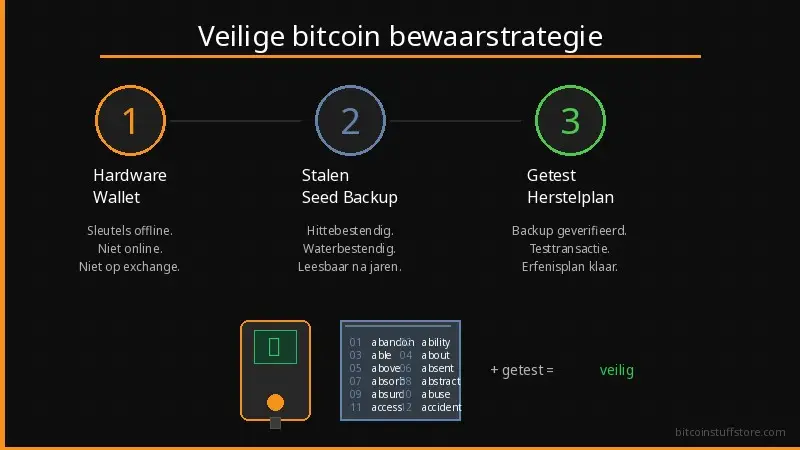
Do you see that your backup is currently mostly paper and good hopes? Then take a look at the Seedfan Steel Kit. Not because steel is magic, but because it is one of the simplest upgrades from vulnerable to more robust.
Are you still mainly in doubt about the device itself? Then doing some research first is smarter than buying blindly. Start with Compare bitcoin and hardware wallet or go directly to the hardware wallet category. Not working harder, choosing smarter.
[Figure 4: Overview photo of hardware wallet plus a steel backup in a home setting. Alt: bitcoin, resolve errors safely while keeping your own copy.]
Conclusion
Storing Bitcoin yourself isn't dangerous because it's too technical. It becomes dangerous when you confuse convenience with security. A photo feels convenient. An exchange feels fast. A passphrase feels smart. Until you discover that your setup was based on unfounded assumptions.
The good version is less spectacular. Offline. Quiet. Tested. Understandable. And honest enough not to add extra layers that you do not carry yet yourself.
You don't have to be a hero to maintain your bitcoin. You just need to prevent predictable mistakes before they become costly. That is the work. And once you see it, you cannot unsee it.